

Sustainability is no longer a design trend; it’s a necessity shaping every layer of the built environment. Across the UK, the US, and globally, architects, developers, manufacturers, and startups are rethinking how spaces are designed, specified, and produced. The pressure to reduce carbon footprints, minimise material waste, and meet regulatory standards is stronger than ever.
According to the UK Green Building Council (UKGBC), the built environment contributes around 25% of the UK’s total greenhouse gas emissions. You can explore more about decarbonisation goals through the UK Green Building Council.
Globally, the construction sector is responsible for nearly 37% of energy-related carbon emissions, as highlighted by the United Nations Environment Programme.
This is where Parametric Furniture Design is stepping into the spotlight.
But what exactly is it, and why is it becoming central to sustainable architecture?
What Is Parametric Furniture Design?
Parametric Furniture Design is a method of designing furniture using algorithm-driven parameters instead of fixed dimensions. Instead of drawing static shapes, designers create rules, relationships, and constraints that define how a piece behaves when dimensions change.
For example:
- Adjusting seat height automatically recalculates support angles.
- Changing room size updates shelving layout proportions.
- Material thickness adjustments modify joint detailing instantly.
This approach allows designers to generate highly customised, material-efficient, and scalable furniture solutions.
When combined with 3D Furniture Design Drawing Services, parametric modelling creates precise digital outputs that are ready for manufacturing.
Why Is Sustainability Driving Parametric Furniture Design?
Sustainable architecture focuses on resource efficiency, durability, adaptability, and waste reduction. Parametric design supports each of these goals.
1️⃣ Material Optimisation
Algorithmic modelling canoptimisee sheet layouts and minimise offcuts. Instead of manually guessing material usage, parametric tools calculate precise cutting patterns.
This reduces:
- Waste during CNC cutting
- Excess raw material procurement
- Transportation emissions
In a UK market increasingly shaped by net-zero targets, such efficiency is critical.
2️⃣ Design for Disassembly
Circular design principles are gaining traction. Furniture must be:
- Repairable
- Modular
- Easy to disassemble
- Reusable
Parametric workflows enable designers to test joint systems digitally before production. With advanced AutoCAD 3D Furniture Design, components can be structured for long-term adaptability rather than one-time installation.
3️⃣ Faster Sustainable Iteration
Sustainability often requires experimentation, adjusting materials, reducing thickness, and testing structural alternatives.
With traditional drafting, each revision takes hours. With parametric systems, adjustments happen instantly.
That means:
- Faster R&D cycles
- Reduced physical prototyping
- Lower energy consumption in early development stages
How Does Parametric Furniture Design Improve CAD Workflows?
The CAD industry in the UK has evolved rapidly in the past decade. Businesses are moving beyond static 2D drawings toward integrated digital ecosystems.
Parametric Furniture Design enhances modern CAD drafting by:
- Automating repetitive tasks
- Maintaining dimensional consistency
- Linking design updates across entire assemblies
- Improving collaboration between architects and manufacturers
When combined with professional 3D Furniture CAD Design Services, parametric modelling ensures precision from concept to shop floor.
For startups and growing furniture brands, this means fewer production errors and better scalability.
Can Parametric Furniture Reduce Prototyping Costs?
Ye, significantly.
Physical prototyping consumes materials, labour, and logistics costs. Digital simulation reduces these dependencies.
Through Photorealistic 3D Furniture, businesses can:
- Validate aesthetics
- Test proportions
- Present to stakeholders
- Secure approvals
This eliminates multiple rounds of costly physical mock-ups.
According to McKinsey research on digital manufacturing transformation, companies adopting digital tools can achieve productivity improvements of 20–30%.
Parametric modelling supports this transformation directly.
Why Is the UK Market Adopting Parametric Design Rapidly?
The UK architecture and interior sector is particularly responsive to innovation for several reasons:
- Strict sustainability targets
- Urban space constraints
- Growing demand for bespoke interiors
- Expansion of modular construction
London-based developers, for example, increasingly require adaptable furniture systems for compact residential units.
Parametric design allows furniture to fit:
- Irregular layouts
- Sloped ceilings
- Multi-functional spaces
For tech-driven architecture firms, partnering with a 3D Furniture Design Company ensures digital consistency across projects.
How Does Parametric Furniture Support Modular Construction?
Modular construction is expanding in both the UK and US markets.
Because modules are prefabricated, precision is critical. Parametric models ensure that built-in furniture aligns perfectly with structural components.
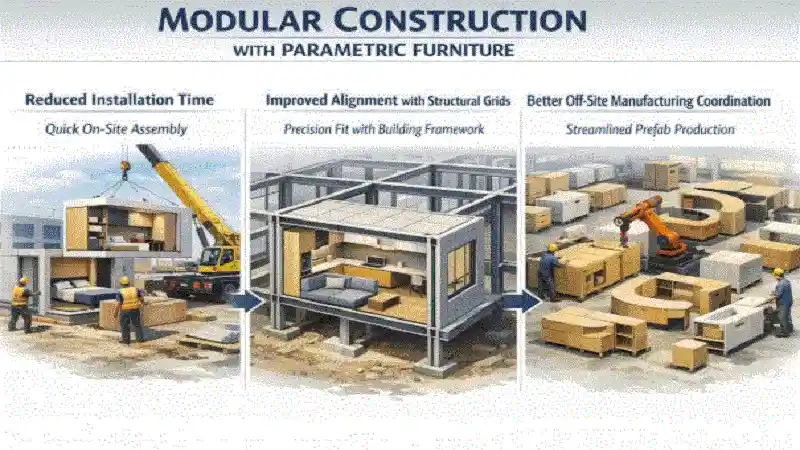
Benefits include:
- Reduced installation time
- Improved alignment with structural grids
- Better off-site manufacturing coordination
When supported by professional Furniture 3D Design Services, parametric systems align architectural intent with fabrication reality.
What Role Does Automation and CNC Integration Play?
Modern furniture manufacturing relies heavily on CNC machines and automated systems.
Parametric designs generate machine-ready data that integrates seamlessly with CNC workflows. This reduces manual translation errors and ensures repeatable precision.
With structured 3D Furniture Design Drawing Services, files can include:
- Cut lists
- Exploded views
- Hardware specifications
- Tolerance settings
This level of digital readiness supports sustainable production by preventing rework and material waste.
Are There Challenges to Implementing Parametric Furniture Design?
While the benefits are significant, there are challenges businesses must address.
1️⃣ Skill Gaps
Advanced parametricmodellingg requires expertise in algorithm-driven design tools.
2️⃣ Initial Investment
Software and training require upfront costs.
3️⃣ Workflow Integration
Businesses must align parametric systems with existing production pipelines.
However, working with experienced providers of 3D Furniture CAD Design Services helps bridge these gaps efficiently.
How Does Parametric Design Improve Client Communication?
Sustainable architecture often involves multiple stakeholders: RSs developers, architects, sustainability consultants, contractors, and end clients.
Parametric workflows combined with Photorealistic 3D Furniture allow stakeholders to:
- Visualise design outcomes
- Review customisations
- Assess material usage
- Understand structural logic
Instead of interpreting flat drawings, clients engage with realistic digital models.
This transparency builds trust and reduces costly late-stage changes.
Is Parametric Furniture Design Suitable for Startups?
Absolutely.
For startups entering competitive UK markets, agility is everything.
Parametric design enables:
- Rapid product variations
- On-demand customization
- Digital-first marketing assets
- Faster production turnaround
By collaborating with a reliable 3D Furniture Design Company, startups can access advanced modelling capabilities without building large in-house teams.
What Does the Future Hold?
The convergence of sustainability, automation, and digital design will continue shaping the furniture industry.
Emerging opportunities include:
- AI-assisted parameter optimisation
- Generative design for material efficiency
- Integrated BIM workflows for interior systems
- Cloud-based collaborative drafting platforms
As sustainable architecture evolves, furniture design can no longer remain isolated.
It must be intelligent, adaptable, and data-driven.
Parametric Furniture Design provides that foundation.
Final Thoughts
If you’re a business owner, architect, or engineer in the UK or globally, the shift toward digital sustainability is not optional.
Parametric design empowers you to:
- Reduce material waste
- Improve production efficiency
- Support modular construction
- Enhance design flexibility
- Lower prototyping costs
It aligns seamlessly with professional 3D Furniture Design Drawing Services, strengthens AutoCAD 3D Furniture Design workflows, and enhances collaboration through Photorealistic 3D Furniture outputs.
While transitioning to parametric systems requires strategic planning, the long-term gains in sustainability, cost control, and competitive advantage are significant.
For businesses seeking structured support in implementing advanced drafting and modelling workflows, partnering with an experienced UK-based CAD specialist can accelerate adoption without overwhelming internal teams.
In a world where sustainable architecture defines industry success, Parametric Furniture Design is not just an iinnovationn it is becoming the standard.
FAQs:
1. What is Parametric Furniture Design?
Parametric Furniture Design is a digital design method that uses adjustable parameters and algorithms to create adaptable, efficient, and customizable furniture models.
2. How does Parametric Furniture Design support sustainable architecture?
It reduces material waste, enables design optimisation, supports modular construction, and minimises physical prototyping through precise digital modelling.
3. Is Parametric Furniture Design popular in the UK?
Yes. With increasing sustainability regulations and net-zero targets, UK architects and manufacturers are adopting parametric workflows to improve efficiency and reduce carbon impact.
4. How do 3D Furniture Design Drawing Services complement parametric modelling?
3D Furniture Design Drawing Services convert parametric concepts into production-ready documentation, including dimensions, joinery details, and CNC-compatible outputs.
5. Can Parametric Furniture Design reduce prototyping costs?
Yes. When combined with Photorealistic 3D Furniture models, businesses can validate aesthetics and functionality digitally before manufacturing physical prototypes.
6. What software is commonly used for Parametric Furniture Design?
Tools like AutoCAD 3D Furniture Design software, BIM platforms, and generative design tools are commonly used to create parametric furniture models.
7. How do 3D Furniture CAD Design Services improve manufacturing accuracy?
They ensure precision in measurements, optimise material layouts, and integrate directly with CNC systems to prevent fabrication errors.
8. Is Parametric Furniture Design suitable for startups?
Absolutely. Startups benefit from faster iterations, customizable product variations, and scalable Furniture 3D Design Services without heavy prototyping costs.
- How does Parametric Furniture Design support modular construction?
Parametric systems ensure furniture dimensions automatically adapt to modular building components, improving installation efficiency and alignment accuracy.
10. Should businesses outsource to a 3D Furniture Design Company?
Outsourcing to an experienced 3D Furniture Design Company can provide expert modelling support, advanced drafting tools, and scalable solutions for sustainable projects. See more: lumondefinition.com